Soundbar Mounting by Car Model | CarInteriorMix
A soundbar can be one of the cleanest ways to upgrade cabin audio without turning your interior into a rolling electronics project. The catch: soundbars weren?t originally designed for cars, and every vehicle cabin has its own ?rules? for space, mounting points, trim shape, and airbag zones. Get it right and you?ll enjoy fuller sound with a factory-like finish. Get it wrong and you?ll fight rattles, blocked visibility, or?worst case?interfere with safety systems.
This guide is built for real owners who want a practical answer to a practical question: Where can a soundbar mount in my specific vehicle? We?ll break down the most common mounting locations, what tends to work by vehicle type and popular models, and how to choose a mount method that won?t damage trim or create headaches later. You?ll also find step-by-step installation tips, product-style comparisons (mount types and power options), common mistakes to avoid, and a quick FAQ.
Quick Compatibility Basics: What Determines Fit?
1) Cabin layout and usable surfaces
Soundbars need a stable, reasonably flat area. The best mounting surfaces share three traits:
- Rigid structure behind the trim (metal crossmembers, thick door cards, seat frames)
- Low vibration (avoid thin plastic panels that buzz)
- Safe placement (not in front of airbags, gauges, or driver sightlines)
2) Power and signal options
Most vehicle soundbar installs fail on wiring rather than ?fit.? Before you pick a mounting spot, confirm:
- Power source: 12V accessory outlet, hardwired to fuse box, or integrated amp power
- Signal: Bluetooth, AUX, USB, RCA line-out converter (LOC), or factory head unit pre-outs
- Turn-on: remote turn-on lead, switched 12V, or auto-sensing input (depends on model)
3) Airbags and safety zones
Many modern cars have airbags in the A-pillars, steering wheel, dash, seats, and curtain airbags along the roofline. As a rule:
- Avoid mounting to A-pillars, headliner edges, and upper door frames where curtain airbags deploy.
- Avoid blocking rear visibility, mirrors, and emergency access to seatbelts and child seat anchors.
- If you?re unsure, treat any trim labeled ?SRS AIRBAG? as a no-mount area.
Most Common Soundbar Mounting Locations (Pros, Cons, Best Use)
Under-seat (front passenger is usually easiest)
- Best for: Compact powered soundbars, clean look, minimal visibility impact
- Pros: Hidden install, short wire runs, stable structure
- Cons: Limited height clearance, seat track movement, potential airflow/heat issues
- Compatibility notes: Works well in many sedans and midsize SUVs; can be tight in small hatchbacks and vehicles with under-seat HVAC ducts
Rear cargo area (SUVs, wagons, hatchbacks)
- Best for: Larger bars, overlanding builds, family vehicles where you want durability
- Pros: More space, easier to mount solidly, less risk of blocking dash controls
- Cons: Longer wiring, can be blocked by cargo, sound may feel ?rear-biased?
- Compatibility notes: Great for SUVs like the Toyota RAV4 and Honda CR-V; works well in Subarus with roomy cargo floors
Behind rear seats / seatback mounting (trucks and some SUVs)
- Best for: Pickups with crew cabs, soundbars designed for truck interiors
- Pros: Protected location, easy to hide wiring, strong mounting points
- Cons: Can interfere with folding seats, storage bins, or child seat access
- Compatibility notes: Common in Ford F-150, Silverado/Sierra, Ram 1500 crew cab builds
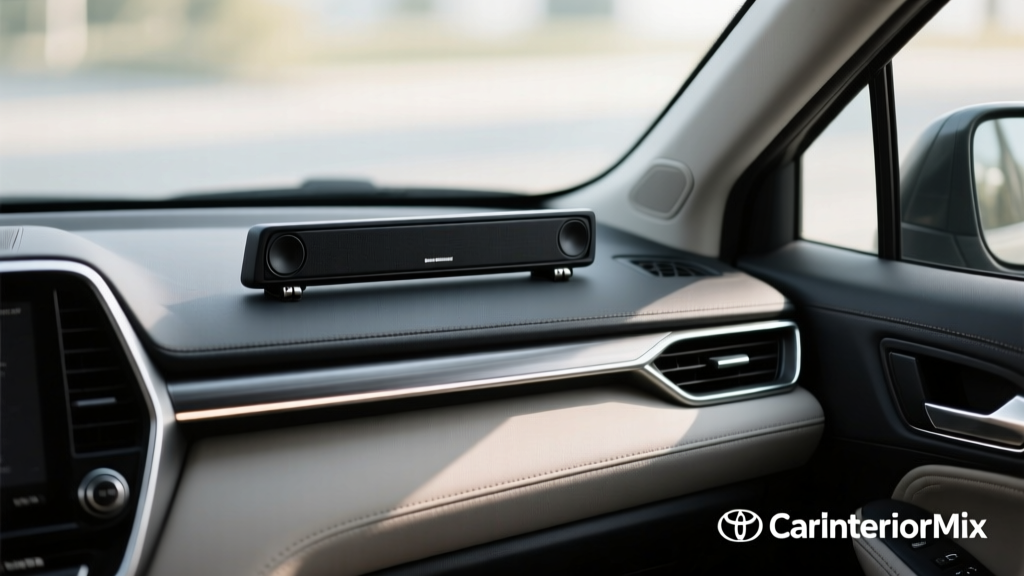
Dashboard / top-of-dash (least recommended)
- Best for: Temporary testing only, ultra-compact bars
- Pros: Simple placement
- Cons: Blocks visibility, sun glare, heat damage risk, airbag risk, theft risk
Overhead / roll bar (specialty off-road vehicles)
- Best for: Jeeps, side-by-sides, open cabins with dedicated mounting tubes
- Pros: Great projection in open air, rugged mounting options
- Cons: Weather exposure, vibration, noise floor is higher
Soundbar Mounting Compatibility by Car Model (Real-World Fit Guidance)
Exact fit depends on the soundbar?s dimensions, seat height, and trim shape, but the patterns below are consistent. Use this section to narrow your best mounting zone before you measure.
Compact Sedans (Toyota Corolla, Honda Civic, Hyundai Elantra, Mazda3 sedan)
- Best mounting choices: Under front passenger seat; occasionally under driver seat if wiring and seat tracks allow
- Usually avoid: Dash mounting (visibility), rear deck (rattle-prone trim)
- What to expect: Tight under-seat clearance. Choose a low-profile soundbar and plan for careful cable routing around seat rails.
- Example: A Corolla owner typically gets the cleanest result by using a slim powered bar under the passenger seat and feeding it audio via Bluetooth or a LOC from rear speaker wires.
Midsize Sedans (Toyota Camry, Honda Accord, Nissan Altima, Hyundai Sonata)
- Best mounting choices: Under-seat is most common; trunk-mounted amps are also practical if you?re going beyond a basic soundbar
- Usually avoid: Rear shelf mounting (sun exposure and rattles)
- What to expect: More space than compacts, but still watch for under-seat HVAC ducts in some trims.
Hatchbacks & Liftbacks (VW Golf, Honda Civic Hatch, Toyota Prius, Kia Forte5)
- Best mounting choices: Under-seat; cargo side panel (if you can anchor to structure); cargo floor (with protection)
- Usually avoid: Loose cargo-area mounting without bracing (hatchbacks amplify rattles)
- What to expect: Cargo soundbars can work well, but secure mounting and anti-rattle padding matter more in hatch cabins.
Small SUVs / Crossovers (Toyota RAV4, Honda CR-V, Mazda CX-5, Subaru Forester)
- Best mounting choices: Cargo area (side or floor), under passenger seat (if clearance allows)
- Usually avoid: Mounting high on interior panels near airbags
- What to expect: Plenty of room, but also more road noise?so a soundbar with a built-in sub or strong midbass response is a better match.
- Example: A CR-V owner who carries gear often does better with a side-mounted cargo setup (bracketed to tie-down points) so the bar isn?t crushed by luggage.
3-Row SUVs (Toyota Highlander, Honda Pilot, Kia Telluride, Ford Explorer)
- Best mounting choices: Cargo area side panel (anchored), behind third row when folded, or under front seats if you want a hidden install
- Usually avoid: Anything that blocks third-row access or interferes with folding mechanisms
- What to expect: You?ll want wiring that can survive seat folding and sliding?use braided loom and anchor points.
Pickup Trucks (Ford F-150, Ram 1500, Chevy Silverado/GMC Sierra, Toyota Tacoma)
- Best mounting choices: Behind rear seat (crew cab), under rear seat (some models), or under front seat (if thin enough)
- Usually avoid: Mounting to thin rear cab wall sheet metal without reinforcement
- What to expect: Trucks are ideal for dedicated ?truck soundbar? products or compact powered bars placed behind the rear bench. Measure seat fold clearance carefully.
- Example: In an F-150 crew cab, a behind-rear-seat mount can look factory-clean if you use existing bolt points and keep the bar clear of seat latch hardware.
Jeeps & Off-Road Icons (Jeep Wrangler, Gladiator, Bronco)
- Best mounting choices: Roll bar / overhead mounts, rear cargo mounts, or specialty brackets designed for open-air cabins
- Usually avoid: Adhesive-only mounts (heat, dust, vibration)
- What to expect: Higher wind and tire noise means you?ll want efficient speakers and secure mounting hardware. Weather resistance matters if you run topless.
EVs & Hybrids (Tesla Model 3/Y, Prius, Hyundai Ioniq 5, Kia EV6)
- Best mounting choices: Under-seat (if ducting allows), cargo area, or removable mounts that don?t interfere with battery cooling pathways
- Usually avoid: Random drilling or tapping near high-voltage components; mounting that compromises underbody or battery-related service access
- What to expect: Cabin is quiet, so small rattles become obvious. Take extra time with foam tape, cable tie-downs, and panel isolation.
Measure First: A Simple Compatibility Checklist
Before ordering anything, grab a tape measure and do a quick fit test.
- Measure the target area (width, depth, and height) and compare it to the soundbar?s body dimensions, not just the marketing photo.
- Check moving parts: seat rails, seat motors, fold-down hinges, and cargo cover tracks.
- Confirm cable path: identify a route that avoids sharp metal edges and won?t be pinched.
- Identify a solid anchor: factory bolts, seat frame bolts, cargo tie-downs, or structural braces are best.
- Plan for ventilation: powered soundbars have amplifiers that need some airflow.
Step-by-Step: Mounting a Soundbar Safely (Universal Workflow)
Tools and supplies (typical)
- Trim removal tools (plastic)
- Socket set / Torx bits (varies by car)
- Zip ties, cable loom, and adhesive-backed tie mounts
- High-quality double-sided mounting tape (3M VHB) for anti-rattle, not primary support
- Foam tape for vibration isolation
- Add-a-fuse tap (for hardwiring) and proper gauge power wire
1) Choose mounting method: brackets, straps, or bolt-on
- Bracket + bolts: Most secure, best for trucks and cargo installs
- Seat-rail strap mounts: Useful under seats when you don?t want to drill
- Industrial Velcro / VHB: Only for lightweight bars and only as a supplement; heat can weaken adhesives
2) Test-fit and mark safe zones
- Place the soundbar in position.
- Slide seats fully forward/back and recline if needed.
- Check for contact with carpet edges, seat wiring, and HVAC ducts.
- Mark anchor points with painter?s tape.
3) Run power the right way
- Disconnect the negative battery terminal before any wiring work.
- For hardwire installs, route power through a fused connection at the fuse box or battery (fuse should be close to the source).
- Ground to a clean, bare-metal chassis point.
- Avoid routing power and audio cables together for long distances to reduce noise.
4) Connect audio signal
- Bluetooth: Easiest, but can add latency and depends on pairing stability.
- AUX/USB: Simple if your head unit supports it and cable routing is clean.
- LOC (line-out converter): Best when integrating with factory radios using speaker-level signals.
5) Secure and de-rattle
- Use foam tape anywhere the soundbar or brackets could touch trim.
- Anchor wiring every 6?10 inches with zip ties or tie mounts.
- Reinstall panels carefully and confirm no wires are pinched.
6) Tune for the cabin
- Start with EQ flat and bass at 25?40%.
- Increase volume until you hear distortion, then back down.
- If bass feels ?boomy,? reduce 60?120 Hz and slightly raise 200?400 Hz for clearer punch.
Recommendations: What Type of Soundbar Works Best in Each Vehicle?
Powered under-seat soundbar (best all-around)
Ideal for sedans and crossovers where you want a stealth install. Look for a slim chassis, adjustable crossover, and speaker-level inputs for factory integration.
- Best for: Corolla, Civic, Camry, Accord, RAV4, CR-V
- Why it works: Minimal space needed, balanced sound improvement, cleaner than a separate amp/sub build
Cargo-area mounted soundbar (best for SUVs and family haulers)
Works well when you have space and want easier service access. Choose a model with durable mounting points and a grille that can handle cargo bumps.
- Best for: Forester, Highlander, Pilot, Telluride
- Why it works: More room for a larger enclosure and less compromise on placement
Rugged / weather-resistant soundbar (best for Jeep-style builds)
If your roof comes off or you?re regularly in dusty environments, prioritize durability over ultra-fine audiophile detail.
- Best for: Wrangler, Gladiator, Bronco
- Why it works: Handles vibration and exposure better than living-room style bars
Common Mistakes to Avoid
- Mounting near airbag zones: Even a ?small? bar can become a hazard if an airbag deploys.
- Using adhesive as the primary mount: Heat cycles can weaken tape; use mechanical support whenever possible.
- Ignoring seat movement: Pinched wires under seat rails are a common failure point.
- Skipping fusing: Every power wire should be fused correctly to prevent electrical damage or fire risk.
- Chasing bass with bad placement: If the bar is blocked by cargo or stuffed in a corner, it may sound worse, not better.
- Not addressing rattles: A great soundbar will reveal weak panels?foam tape and secure clips are part of the install.
FAQ: Soundbar Mounting Compatibility
Will a soundbar fit under my seat?
Many will, but you have to measure height clearance at the lowest point (often the seat crossbar or HVAC duct). If you have powered seat motors or under-seat vents, choose a very slim model and confirm the seat can still travel fully.
Can I mount a soundbar to the dashboard?
It?s rarely the best idea. Dash mounting can block your view, bake the unit in direct sun, and may interfere with passenger airbag zones. If you want front-stage sound, a better approach is door speakers + a compact under-seat solution.
What?s the best mounting spot in an SUV?
For most small and midsize SUVs, the cargo area side mount or under the front passenger seat offers the best balance of space, safety, and clean wiring. If you regularly carry cargo, prioritize a protected side location using tie-down anchors.
Do I need an amplifier if the soundbar is powered?
No?powered soundbars include their own amp. You may still need a line-out converter (LOC) if you?re integrating with a factory radio that doesn?t have RCA outputs.
How do I avoid alternator whine or buzzing?
Keep power and audio wires separated, use a solid chassis ground, and avoid cheap unshielded RCA cables. If you?re using a LOC, pick a quality unit and mount it securely to prevent noise from vibration.
Is drilling into my car required?
Not always. Many installs can use existing bolts (seat bolts, cargo tie-downs) or bracket adapters. If drilling is necessary, only drill into safe, non-structural areas?and never where you can hit wiring, fuel lines, or safety components.
Next Steps: Find Your Best Fit and Install with Confidence
Start by choosing your mounting location (under-seat, cargo, behind-seat), then measure twice and plan your wiring route before buying. If you want the cleanest, most universally compatible approach for everyday vehicles, a slim powered under-seat soundbar is usually the safest bet. For trucks and adventure rigs, a behind-seat or rugged overhead mount can deliver the best real-world performance.
If you?re ready to move forward, gather your measurements, confirm your power/audio strategy, and sketch a quick layout of where the bar and wiring will sit. You?ll save time, avoid rattles, and end up with a setup that looks like it belongs in your car.
Explore more practical interior upgrade guides at carinteriormix.com to keep your cabin clean, comfortable, and better sounding with every mod.